
Search TAIHUA Products
Learn what custom watch winder packaging should include, from branded retail boxes and protective inserts to accessories, manuals, export cartons, shipping protection, and private label packaging requirements.
Category:Private Label & Branding
Author:TAIHUA Admin
Date:2026-11-12
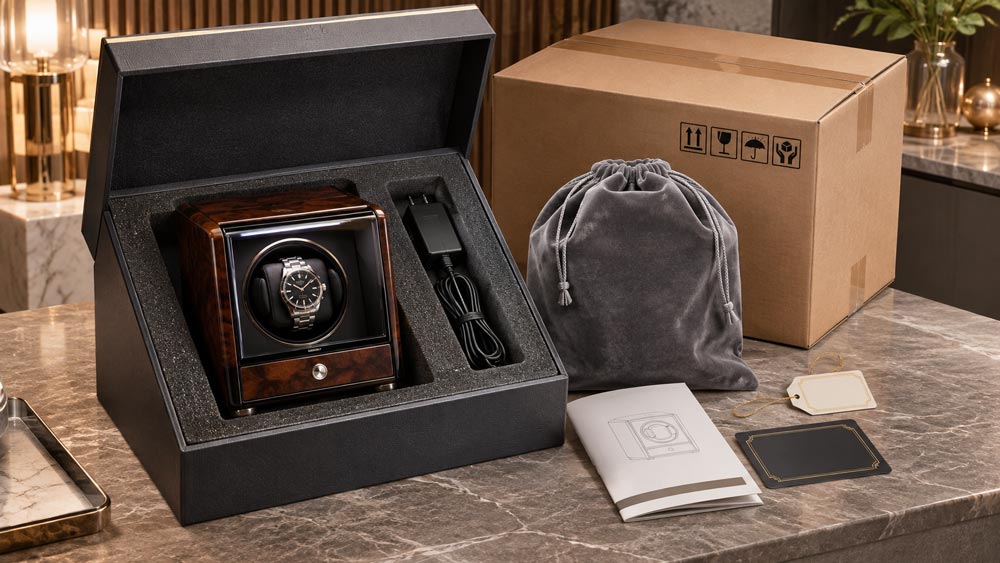
Custom watch winder packaging should include a branded retail box, protective internal inserts, secure product positioning, accessory compartments, user documentation, product labels, and a suitable export carton. Effective packaging combines brand presentation with protection during international transportation.
A complete custom watch winder packaging system should contain eight main components: an outer retail box, internal cushioning, product fixation, accessory storage, printed documentation, product identification, an export carton, and transportation labels.
Each component serves a different purpose.
| Packaging Component | Main Function | Customization Options |
|---|---|---|
| Retail Box | Brand presentation and product identification | Logo, colors, graphics, and finishes |
| Protective Inserts | Cushioning and impact protection | Foam, molded inserts, and custom compartments |
| Product Fixation | Preventing movement inside the box | Positioning supports and retaining structures |
| Accessory Compartment | Organizing adapters and included accessories | Separate accessory spaces |
| User Documentation | Providing operating and product information | Branded manuals and warranty information |
| Product Labels | Identifying the product and specifications | Model labels and brand identification |
| Export Carton | Protecting goods during transportation | Carton dimensions and strength |
| Shipping Labels | Supporting logistics and handling | Shipping marks and handling symbols |
For private label watch winder brands, these components should be planned together rather than purchased or designed independently.
A premium retail box may improve product presentation, but it cannot replace proper internal cushioning. Similarly, strong export packaging does not automatically create a professional retail experience.
The most effective packaging design balances four objectives:
Protect the watch winder and its accessories.
Present the product consistently with the brand identity.
Organize all included components.
Reduce unnecessary packaging volume and transportation costs.
The retail box is the first packaging element customers see. It should communicate the brand identity, product category, and product positioning.
For private label projects, the box should follow the same visual standards as the watch winder itself.
Important customization elements include:
| Retail Box Element | Recommended Content |
|---|---|
| Front Panel | Brand logo and product name |
| Side Panels | Product capacity and key specifications |
| Back Panel | Product description and technical information |
| Interior Surface | Brand presentation and product identification |
| Product Label | SKU or model identification |
| Printed Graphics | Brand colors, typography, and visual elements |
Yes. A consistent packaging design helps establish a recognizable product collection.
For example, a private label brand offering four configurations can use the same logo placement, typography, and color system across all four products.
However, the box dimensions and internal inserts should be adapted to each product.
A single packaging design does not mean using identical box sizes for every model.
The packaging should reflect the actual dimensions of each watch winder while maintaining a unified brand appearance.
Several finishes can support different retail positions:
Matte laminated surfaces for a restrained presentation.
Gloss finishes for a more reflective appearance.
Embossed or debossed logos for added visual and tactile detail.
Printed brand graphics for product identification.
Customized interior colors for coordinated presentation.
The appropriate finish depends on the product's exterior materials and the intended retail positioning.
A wooden watch winder may benefit from packaging that emphasizes its classic appearance, while a modern PU leather model may use a more contemporary visual direction.
Internal cushioning is essential because watch winders contain mechanical and electronic components as well as finished exterior surfaces that can be damaged during transportation.
The internal packaging should hold the product securely and prevent direct contact between vulnerable components and the outer carton.
Common protective materials include:
| Protective Material | Main Characteristics | Typical Packaging Use |
|---|---|---|
| EPE Foam | Lightweight cushioning and shock absorption | Product positioning and protective inserts |
| EVA Foam | Structured cushioning and a clean finished appearance | Custom-shaped product compartments |
| PE Foam | Lightweight protection and separation | Internal supports and accessory protection |
| Molded Pulp | Formed protective structure | Selected product packaging designs |
| Protective Fabric Bags | Surface protection against rubbing and scratches | Exterior finish protection |
| Corrugated Inserts | Structural separation and cushioning | Inner packaging support |
The material should be selected according to product weight, structure, and transportation requirements.
A watch winder has several components that deserve particular attention.
1. Glass or Transparent Panels
Glass doors and display panels should be protected against direct impact and pressure. The packaging insert should support the surrounding structure without placing excessive pressure on the glass.
2. Exterior Finish
Wood-grain surfaces, PU leather, coated panels, and decorative finishes should be protected from abrasion and scratches.
A suitable protective bag or non-abrasive separation layer can help reduce surface contact during transportation.
3. Doors and Hinges
Doors should remain stable during shipment. Excessive movement can create pressure on hinges, glass panels, and closing mechanisms.
4. Control Panels
Touchscreens, buttons, and electronic control areas should not be exposed to direct pressure from packaging inserts or accessories.
5. Internal Watch Cushions
Watch cushions and winding compartments should be positioned to prevent unnecessary movement during transportation.
The objective is to protect the complete product rather than focusing only on the outer housing.
A watch winder should be positioned firmly inside its packaging so that it cannot move freely during transportation.
Internal packaging should be designed around the actual product dimensions, weight distribution, and vulnerable areas.
Three elements are important.
Protective inserts should match the external structure of the selected watch winder.
A compact single-watch winder and a nine-watch winder have different dimensions and weight distributions. Their internal supports should therefore be designed separately.
The product should remain stable when the package is lifted, tilted, or subjected to normal transportation handling.
Suitable supports can be positioned around the product's structural areas to reduce unnecessary movement.
Adapters, cables, and other included accessories should have designated storage spaces.
Accessories should not move freely inside the box or come into direct contact with the watch winder's exterior surfaces.
Product capacity affects packaging size, internal structure, and transportation requirements.
| Product Configuration | Packaging Considerations |
|---|---|
| Single Watch Winder | Compact insert and secure product positioning |
| Double Watch Winder | Additional internal support and accessory separation |
| 4-Watch Winder | Larger protective structure and balanced positioning |
| 6-Watch Winder | Increased packaging dimensions and structural support |
| 9-Watch Winder | More extensive internal protection and carton planning |
Larger products may require more substantial packaging because of their dimensions and weight.
However, packaging should be designed according to actual product measurements rather than capacity alone.
A retail-ready watch winder package should include all accessories and documentation specified for the selected product.
A complete accessory list helps buyers prevent missing components and reduces confusion during product inspection.
| Item | Purpose | Packaging Requirement |
|---|---|---|
| Power Adapter | Supplies electrical power | Separate accessory compartment |
| Power Cable | Connects the product to its power source | Organized cable storage |
| Remote Control | Operates supported models | Protected storage space |
| User Manual | Explains operation and settings | Printed or digital documentation |
| Warranty Information | Explains applicable warranty arrangements | Printed insert or document |
| Keys | Supports models with compatible locking systems | Secure accessory storage |
| Product Information Card | Identifies product features and specifications | Branded printed insert |
Not every watch winder includes every accessory. The final packaging list should match the actual product configuration and approved purchase order.
A clear manual should provide the information customers need to operate the product correctly.
Recommended sections include:
Product overview and included accessories.
Power connection instructions.
Control panel operation.
Rotation direction settings.
TPD selection.
Operating and rest cycles.
Basic maintenance.
Troubleshooting information.
Safety instructions.
Warranty and customer support information.
The instructions should match the actual functions of the selected model.
For example, a manual for a touchscreen watch winder should not contain operating instructions intended for a button-controlled model.
Yes. Customized manuals help maintain a consistent brand identity and make product information easier to manage.
A branded manual can include the company logo, product name, product images, technical specifications, and customer support information.
For brands selling in multiple countries, language requirements should also be considered when preparing the documentation.
Custom packaging should identify the brand and communicate accurate product information.
The printed content should be useful to distributors, retailers, and end customers.
Recommended information includes:
| Information | Recommended Content |
|---|---|
| Brand Identity | Brand logo and company name |
| Product Name | Watch winder product category |
| Capacity | Number of winding positions |
| Main Functions | Supported winding and control features |
| Technical Information | Dimensions and power specifications |
| Product Identification | SKU or model reference |
| Origin Information | Country of origin where applicable |
| Support Information | Website or customer support details |
Yes. Basic specifications can help retailers identify products and allow customers to understand the product configuration.
For example, a package may identify:
Four-watch winding capacity.
Available rotation directions.
Supported TPD programs.
Power adapter specifications.
Exterior material.
Only verified product information should appear on the packaging.
A product with four winding positions should not be described as having six winding positions simply because it includes additional watch storage.
Yes. QR codes can link to digital product manuals, operating videos, warranty registration, or customer support information.
For private label brands, this provides a practical way to maintain product information without printing extensive documentation on every box.
The QR destination should remain accessible and should point to the correct product information.
Retail packaging and export packaging have different purposes, and a complete B2B packaging solution should address both.
Retail packaging focuses on brand presentation and customer experience. Export packaging focuses on protecting the product during storage, handling, and transportation.
| Comparison | Retail Packaging | Export Packaging |
|---|---|---|
| Main Purpose | Product presentation | Transportation protection |
| Main Material | Printed box and finished inserts | Corrugated cartons and protective materials |
| Branding | Prominent logo and graphics | Product and shipping identification |
| Internal Structure | Product presentation and organization | Shock protection and movement prevention |
| Main Concern | Appearance and retail readiness | Strength, dimensions, and shipping safety |
An export carton should be selected according to the packaged product's gross weight, dimensions, stacking conditions, and transportation method.
Important considerations include:
Suitable corrugated board strength.
Adequate internal cushioning.
Secure carton closure.
Clear product identification.
Correct carton quantity.
Gross and net weight information.
Package dimensions.
Appropriate handling symbols.
For larger or heavier watch winders, carton strength and stacking resistance deserve particular attention.
The retail box should not automatically be treated as the final shipping carton. A separate outer carton can provide additional protection during international transportation.
Solid wood packaging materials used in international trade may be subject to ISPM 15 requirements.
These requirements generally concern wooden pallets, crates, and dunnage used to support or protect cargo.
The standard includes approved treatment and marking requirements. Importing-country rules should be checked before shipment.
For example, the United States requires regulated wood packaging material entering or transiting the country to meet ISPM 15 treatment and certification requirements.
Processed wood products such as plywood and oriented strand board are treated differently from regulated solid wood packaging under applicable exemptions.
The requirement should therefore be assessed according to the actual packaging material and destination market.