
Search TAIHUA Products
Learn how to source watch winders for retail businesses. Compare suppliers, product ranges, MOQ, customization, samples, and bulk purchasing requirements.
Category:Wholesale Buying & Sourcing
Author:TAIHUA Admin
Date:2026-10-31
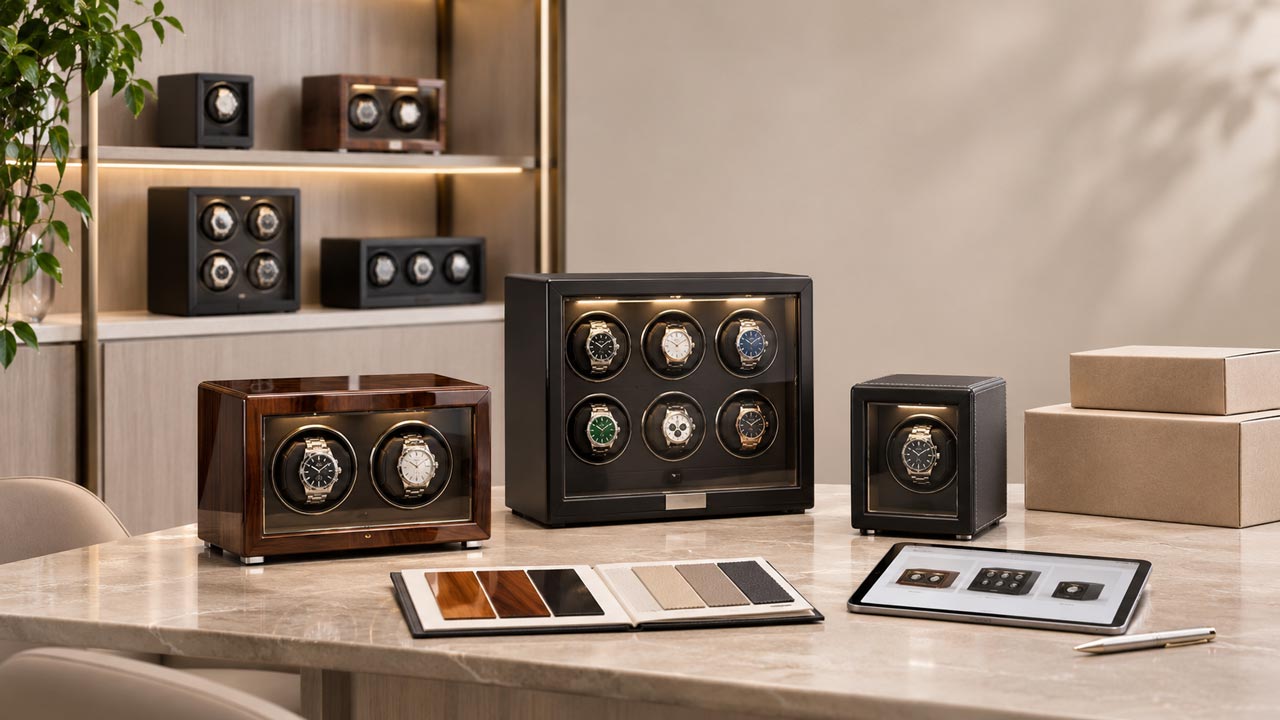
Retailers should source watch winders by matching product capacity, winding functions, finish, and price to their customer base, then verifying supplier consistency through written specifications, samples, MOQ terms, packaging checks, and a controlled first bulk order.
Watch winders offer retailers a complementary product category for customers who own automatic mechanical watches. They create additional sales opportunities beyond watches themselves and allow retailers to serve customers looking for practical accessories, watch storage, and presentation solutions.
The wider watch market provides useful context for this purchasing decision.
According to the Federation of the Swiss Watch Industry, Swiss watch exports reached CHF 24.4 billion in 2025, representing approximately 14.6 million exported watches. However, export volume declined by 4.8% compared with 2024. This indicates that retailers need to pay attention to product positioning, customer expectations, and inventory decisions rather than relying on market growth alone.
The 2025 Swiss Watch Industry Study also found that 38% of surveyed consumers preferred purchasing watches from multi-brand retailers, compared with 23% who preferred mono-brand boutiques. Additionally, 40% of Generation Z respondents indicated an intention to purchase a pre-owned watch within the following 12 months.
These findings highlight the importance of serving different customer groups and maintaining relevant product assortments.
For retailers, watch winders can complement several existing business categories:
Watch retailers can offer winding accessories alongside automatic watches.
Jewelry stores can expand their selection of premium gift and watch accessories.
Pre-owned watch dealers can provide complementary products for mechanical watch owners.
Watch accessory brands can introduce watch winders as an additional product category.
Distributors can expand their existing watch accessory portfolios.
The opportunity is not simply to purchase another product. It is to introduce a complementary category that fits the retailer's existing customer base.
Product selection should begin with customer purchasing behavior rather than the number of available models.
A retailer serving customers who own one automatic watch has different requirements from a specialist watch dealer serving collectors with multiple timepieces.
The following capacity structure provides a practical starting point.
| Product Configuration | Target Customers | Retail Positioning |
|---|---|---|
| Single Watch Winder | First-time automatic watch owners and gift buyers | Entry-level accessory |
| Double Watch Winder | Couples and customers with multiple automatic watches | Mainstream retail option |
| 3–4 watch winder | Watch enthusiasts and growing collectors | Mid-range collection |
| 6–9 watch winder | Experienced collectors and premium customers | Premium collection |
| 12+ Watch Winder | Large-collection owners and specialist retailers | High-capacity solution |
Retailers should also consider the relationship between product capacity and selling price.
A single watch winder generally requires less storage space and offers a more accessible product entry point. Larger configurations provide more capacity but also involve higher material, packaging, and shipping requirements.
A balanced product range should cover three purchasing levels:
1. Entry-Level Selection
Compact single and double watch winders are suitable for retailers introducing the category or serving customers with smaller collections.
2. Core Retail Selection
Three-slot and four-slot products provide additional choices for customers who own several automatic watches.
3. Premium Selection
Six-slot and larger configurations address customers seeking higher-capacity winding and more substantial display solutions.
The right assortment depends on the retailer's customer profile, sales channel, and available inventory budget.
A reliable watch winder supplier should offer more than an attractive product catalog. Buyers need to evaluate product consistency, technical specifications, customization capabilities, commercial terms, and ongoing supply support.
Six areas deserve particular attention.
| Evaluation Area | What Buyers Should Check |
|---|---|
| Product Range | Available capacities, designs, materials, and configurations |
| Winding Performance | Motor operation, rotation direction, TPD settings, and operating cycles |
| Product Quality | Construction, surface finish, cushion fit, and functional testing |
| Branding Support | Logo application, color options, and private-label possibilities |
| Commercial Terms | MOQ, pricing tiers, sample costs, and production lead time |
| Retail Support | Product images, specifications, packaging, manuals, and after-sales assistance |
A practical supplier assessment can use a 100-point scoring framework.
| Assessment Category | Weight |
|---|---|
| Product Range and Market Fit | 20 points |
| Winding Functions and Compatibility | 20 points |
| Product Construction and Quality Evidence | 20 points |
| Branding and Packaging Support | 15 points |
| Commercial Terms and Supply Reliability | 15 points |
| Retail and After-Sales Support | 10 points |
| Total | 100 points |
A suggested internal evaluation rule is:
80–100 points: Suitable for supplier shortlisting.
65–79 points: Requires further verification or commercial negotiation.
Below 65 points: Significant concerns should be resolved before proceeding.
This is a proposed buyer evaluation framework, not an industry certification standard.
The most important consideration is whether the supplier can maintain the same product specifications and quality standards across repeated orders.
A sample that performs well does not automatically guarantee consistent bulk production. Buyers should therefore evaluate both the product and the supplier's ability to reproduce the approved specifications.
Watch winders are functional products. Their technical specifications directly influence compatibility, operating performance, and customer satisfaction.
Retail buyers should request a complete specification sheet before confirming an order.
| Technical Item | Information to Confirm | Why It Matters |
|---|---|---|
| Motor Type | Motor model and operating characteristics | Determines winding performance and operating consistency |
| Rotation Direction | Clockwise, counterclockwise, or bidirectional | Must match the watch movement's requirements |
| TPD Settings | Available turns per day | Determines the winding program |
| Operating Cycle | Rotation and rest intervals | Helps prevent unnecessary continuous operation |
| Noise Level | Measured operating noise in dB | Important for residential and bedroom use |
| Power Supply | Adapter specifications and battery options | Affects market compatibility |
| Watch Pillow | Adjustable dimensions and fitting range | Determines how securely different watches are held |
| Exterior Material | Wood, leather, MDF, metal, or other finishes | Influences appearance and positioning |
| Interior Material | Microfiber, velvet, or other lining | Affects watch presentation and contact protection |
| Control System | Buttons, touchscreen, remote, or other controls | Influences operating convenience |
Several specifications deserve additional attention.
Motor and Rotation Performance
The motor should provide stable rotation according to the selected winding program. Buyers should confirm the available rotation directions and whether the device includes programmed rest periods.
TPD Configuration
TPD refers to turns per day. Different automatic watch movements have different winding requirements.
A supplier should provide the actual TPD options supported by each model rather than relying on general compatibility statements.
Noise Performance
Noise claims should be supported by measurable information. Buyers should request the tested noise level and understand the testing conditions.
Power Compatibility
Power adapters, voltage specifications, plug types, and battery operation should be confirmed according to the destination market.
A product suitable for one market may require different power accessories for another.
Minimum order quantity is one of the most important considerations when developing a new retail product category.
However, watch winder MOQ is not necessarily a single fixed number. It can vary according to the selected model, materials, branding requirements, and packaging specifications.
Buyers should request separate MOQ information for:
Standard watch winder models.
Orders with customized logos.
Different exterior colors or finishes.
Customized retail packaging.
Mixed-model wholesale orders.
The distinction between standard products and customized products is particularly important.
A standard model may already be available for production, while a private-label order may require additional preparation for branding, packaging, or product identification.
Comparing suppliers only by unit price can lead to inaccurate purchasing decisions.
A complete wholesale cost calculation should include:
| Cost Component | Purchasing Consideration |
|---|---|
| Product Unit Price | Base cost of each watch winder |
| Branding Cost | Logo printing, engraving, or nameplate |
| Packaging Cost | Retail box, protective inserts, and carton |
| Accessories | Power adapter, cable, manual, and other included items |
| Sample Cost | Product samples and customization preparation |
| Freight Cost | International shipping and transportation |
| Import Expenses | Applicable duties, taxes, and customs charges |
For a more accurate comparison, request quotations at three purchasing levels:
Initial trial order.
Planned regular wholesale order.
Higher-volume replenishment order.
This makes it easier to understand how pricing changes as purchasing volume increases.
Buyers should also compare quotations under the same shipping terms. EXW, FOB, and DDP quotations do not represent the same cost responsibilities.
The final decision should be based on total landed cost and expected retail margin rather than the lowest factory quotation.
Yes. Product sampling is an essential step before committing to wholesale purchasing.
A physical sample allows buyers to evaluate product performance, appearance, materials, packaging, and actual operating functions.
For the most reliable comparison, the sample should use the same configuration intended for bulk production.
A practical sample inspection can cover 12 points:
| No. | Inspection Item | What to Verify |
|---|---|---|
| 1 | Exterior Appearance | Surface finish, color consistency, and visible defects |
| 2 | Product Construction | Panel joints, structure, and assembly |
| 3 | Watch Pillow | Fit, adjustment, and holding stability |
| 4 | Rotation Direction | Correct clockwise and counterclockwise operation |
| 5 | TPD Settings | Available programs and setting accuracy |
| 6 | Rest Intervals | Whether programmed operating cycles work correctly |
| 7 | Motor Noise | Unusual noise, vibration, or inconsistent operation |
| 8 | Start and Stop | Reliable response during repeated operation |
| 9 | Control Panel | Button, touchscreen, and display functions |
| 10 | Power Supply | Adapter, voltage, and connection compatibility |
| 11 | Additional Features | Lighting, locking, or other specified functions |
| 12 | Packaging | Internal protection, accessories, and carton condition |
A preliminary functional assessment should include at least three complete programmed winding and rest cycles where the product's operating program permits.
A longer observation period, such as 72 hours, can also help identify obvious operating problems. However, this does not replace formal durability testing.
A golden sample is the approved reference product used to control subsequent production.
After the buyer confirms the sample, the supplier should retain an agreed reference covering:
Product dimensions and construction.
Exterior material and finish.
Interior lining and watch cushion.
Motor and control configuration.
Logo position and appearance.
Packaging materials and printed information.
Any significant changes should be approved before production continues.
This process reduces the risk of receiving bulk products that differ from the approved sample.
Branding and packaging are important when watch winders are sold under a retailer's or accessory brand's own identity.
A product may perform correctly but still be difficult to integrate into an established retail collection if its appearance, logo presentation, and packaging do not match the brand.
Buyers should evaluate three levels of private-label support.
Level 1: Basic Branding
Custom logo application.
Brand nameplate.
Product identification.
Level 2: Product Appearance
Selected exterior colors.
Available material and finish options.
Interior color coordination.
Consistent visual presentation.
Level 3: Retail Packaging
Customized product boxes.
Brand labels and inserts.
User manuals.
Protective packaging.
Product identification information.
Not every model supports every customization option. Buyers should confirm the available options for each selected product before placing an order.
A retail-ready watch winder package should normally contain:
The watch winder unit.
The corresponding power adapter.
Required connection accessories.
An operating manual.
Product identification information.
Protective internal packaging.
Additional inserts or branding materials can be included according to the retailer's requirements.
Packaging should also be evaluated for international transportation. Product protection, carton strength, internal positioning, and moisture protection all influence the condition of goods upon arrival.
For distributors and retailers, consistent packaging is important because damaged products can create additional costs, customer complaints, and returns.
Previous:
Next: