
Search TAIHUA Products
Learn how to start a private label watch winder collection, from selecting products and customizing logos to MOQ, packaging, supplier evaluation, and retail marketing preparation.
Category:Private Label & Branding
Author:TAIHUA Admin
Date:2026-11-09
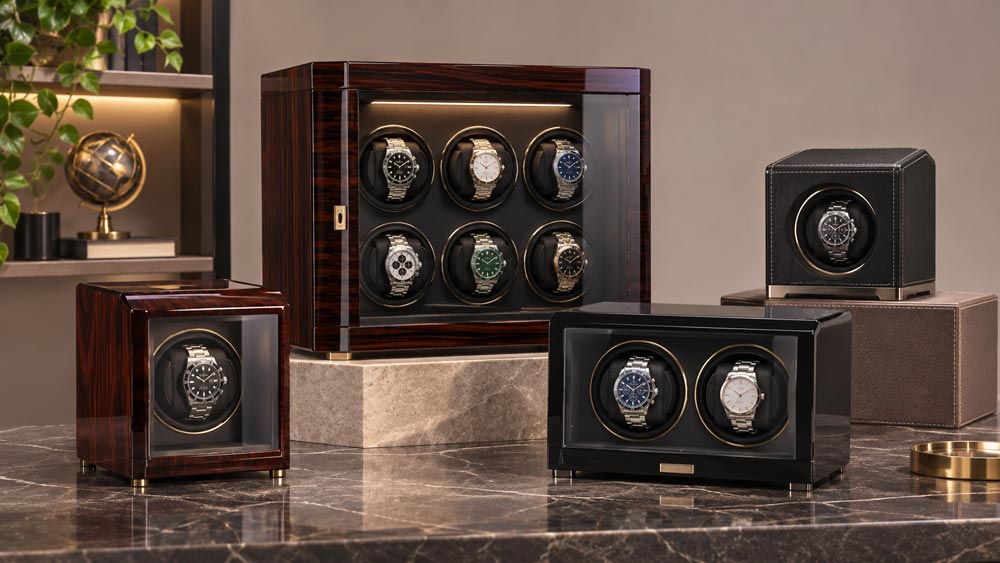
Starting a private label watch winder collection requires selecting suitable products, defining brand positioning, confirming customization options, and planning retail packaging. A practical starting range is 3–5 complementary SKUs supported by consistent branding and quality checks.
A private label watch winder collection is a group of watch winders supplied under a retailer's or brand owner's own brand name. The products may be selected from existing manufacturing designs and customized with logos, packaging, labels, and retail materials.
Unlike purchasing unbranded products for resale, private labeling creates a recognizable product identity across multiple models.
A complete collection typically includes five elements:
Product Selection: Different capacities, appearances, and functional configurations.
Brand Identity: Logo placement, product labels, and consistent visual presentation.
Retail Packaging: Branded boxes, protective inserts, and product manuals.
Product Information: Specifications, product photography, and marketing descriptions.
Supply Planning: MOQ, production arrangements, quality inspection, and replenishment.
The objective is not simply to customize individual products. It is to create a product range that customers can recognize as belonging to the same brand.
A new private label brand can start with 3–5 carefully selected watch winder models. This provides enough product variety to test different customer preferences without creating excessive inventory and purchasing complexity.
The best starting collection should cover different buying requirements rather than offering several products with almost identical designs.
A practical collection structure could look like this:
| Product Type | Main Positioning | Target Customer |
|---|---|---|
| Single Watch Winder | Entry-level product | First-time buyers and compact collections |
| Double Watch Winder | Everyday retail option | Customers with two automatic watches |
| 4-Watch Winder | Expanded capacity | Watch collectors |
| Premium Wooden Watch Winder | Premium appearance | Luxury-oriented customers |
| Multi-Watch Winder | Higher-capacity collection | Experienced collectors |
These products represent different retail positions and provide opportunities to test which configurations generate stronger demand.
Launching 10–20 models at the beginning may increase purchasing commitments, packaging preparation, photography costs, and inventory management requirements.
A smaller collection offers several advantages:
Easier product positioning.
More concentrated marketing resources.
Simpler inventory management.
Better control over branding consistency.
More manageable initial purchasing quantities.
For example, a brand launching four models can allocate its initial budget across four distinct product positions instead of spreading resources across 15 similar products.
After collecting sales data, the product range can expand according to actual customer demand.
Product selection should begin with the target customer and intended retail price positioning, not simply the number of available models.
A successful collection needs a clear relationship between its products.
Different retail markets may require different product combinations.
| Target Market | Suggested Product Direction |
|---|---|
| Watch Accessory Retailers | Single and double watch winders |
| Jewelry Stores | Attractive finishes and retail-ready packaging |
| Watch Collectors | Double, 4-watch, and multi-watch configurations |
| Premium Gift Retailers | Premium finishes and presentation packaging |
| Watch Accessory Brands | Consistent product styling and private-label branding |
For example, a retailer targeting entry-level customers may prioritize compact single and double watch winders. A premium collector-oriented brand may require larger capacities and more sophisticated exterior finishes.
A practical collection should include different product positions.
Entry-Level: A Compact Single Watch Winder with straightforward controls.
Core Range: A double watch winder for customers with multiple automatic watches.
Expanded Range: A 4-watch configuration for collectors.
Premium Range: Products with distinctive finishes, display features, or additional storage.
This structure gives customers a clear reason to choose between products.
Before selecting a model, buyers should evaluate:
| Specification | What to Check |
|---|---|
| Capacity | Number of watches supported |
| Motor System | Motor arrangement and operating performance |
| TPD | Available turns-per-day settings |
| Rotation | Clockwise, counterclockwise, and bidirectional options |
| Exterior | Wood, MDF, PU leather, and other finishes |
| Controls | Buttons, digital displays, or touchscreens |
| Power Supply | Voltage, adapter, and plug requirements |
| Dimensions | Product size and packaging dimensions |
Products with similar appearances may have different internal configurations. Technical specifications should therefore be confirmed before the collection is finalized.
Most private label projects begin with existing product designs and focus on branding, appearance, and retail presentation.
Customization can be organized into three practical levels.
This is suitable for brands testing a new product category.
Typical options include:
Logo printing.
Laser-engraved branding where suitable.
Metal nameplates.
Product labels.
Branded product identification.
The objective is to establish a recognizable brand identity without significantly changing the existing product structure.
This level focuses on preparing products for direct retail distribution.
Typical options include:
Customized exterior colors or finishes where available.
Branded retail packaging.
Printed product manuals.
Product labels and identification.
Protective packaging inserts.
A consistent appearance across different products helps customers recognize the collection as one brand.
This approach is more suitable for established accessory brands and distributors.
Instead of customizing each product separately, the entire product range follows a coordinated branding direction.
It may include:
Consistent logo placement.
Unified packaging design.
Coordinated product labels.
Standardized product information.
Consistent product photography.
Shared marketing materials.
The main benefit is brand consistency across multiple watch winder configurations.
Actual customization availability depends on the selected product, materials, production arrangements, and supplier confirmation.
The initial investment depends on the number of selected models, purchasing quantities, customization requirements, samples, packaging, and transportation.
There is no universal startup price because a three-model collection with standard branding is very different from a five-model collection with customized retail packaging.
The initial budget should be divided into six cost categories.
| Cost Category | Main Expenses |
|---|---|
| Product Samples | Sample units and sample transportation |
| Product Purchasing | MOQ and production unit costs |
| Logo Customization | Printing, engraving, and nameplates |
| Retail Packaging | Customized boxes, inserts, and manuals |
| Marketing Materials | Photography, videos, and product descriptions |
| Logistics | Freight, insurance, customs duties, and local delivery |
A simple planning formula is:
Initial Investment = Sample Costs + Product Purchasing + Branding + Packaging + Marketing Materials + Logistics
For example, consider a hypothetical four-SKU launch:
4 selected product models.
10 units per model.
40 total units.
1 branding direction.
1 coordinated packaging design.
The total product quantity is:
4 models × 10 units = 40 units.
This example is a planning scenario, not a confirmed MOQ or actual supplier quotation.
The final investment must also account for whether the supplier accepts mixed-model orders and whether customized packaging has separate minimum production quantities.
Three methods can help control the first purchasing investment.
1. Select Existing Product Designs
Using existing product structures can reduce development requirements compared with requesting completely new product designs.
2. Standardize Branding
Using one logo system, consistent label specifications, and coordinated packaging across multiple models can simplify production preparation.
3. Prioritize Core Products
Begin with the models most closely aligned with the target market. Additional products can be introduced after reviewing sales performance.
MOQ depends on the product configuration, supplier production arrangements, and customization requirements.
There is no single MOQ that applies to every watch winder or every private label project.
The MOQ for the product itself may differ from the minimum quantity required for custom packaging, printed manuals, or other branded components.
Buyers should confirm four separate quantities:
| MOQ Category | What to Confirm |
|---|---|
| Product MOQ | Minimum units required for each selected product |
| Mixed-Model MOQ | Whether different models can be combined |
| Logo MOQ | Minimum quantity for the selected branding method |
| Packaging MOQ | Minimum quantity for customized retail boxes |
Mixed-model purchasing may help new brands build a broader collection without committing to large quantities of a single product.
For example, an initial order could combine:
10 single watch winders.
10 double watch winders.
10 four-watch winders.
10 premium wooden watch winders.
This creates a 40-unit mixed-model order.
However, the actual feasibility depends on the supplier's MOQ policy, component availability, and packaging arrangements.
A written quotation should specify whether MOQ is calculated per model or across the complete order.
A suitable supplier should provide more than product availability. The supplier should also support consistent specifications, branding arrangements, packaging preparation, and repeat orders.
Six areas deserve particular attention.
Check whether the supplier can provide complementary single, double, and multi-watch configurations.
A supplier with a suitable product range makes collection planning easier.
Confirm available logo methods, exterior finishes, packaging options, and product labeling.
Do not assume every customization method is available for every product.
Request physical samples before approving bulk production.
Samples allow buyers to inspect the actual finish, motor operation, control functions, dimensions, and packaging.
Ask how the supplier checks:
Motor operation.
Rotation direction.
TPD settings.
Operating noise.
Electronic controls.
Exterior finish.
Power supply.
Packaging protection.
These checks should correspond to the actual product configuration.
Confirm the production lead time, order confirmation process, packaging preparation, and shipping arrangements.
The quotation should distinguish sample lead time from bulk production lead time.
Discuss spare parts availability, replacement arrangements, technical documentation, and procedures for handling quality issues.
These factors become increasingly important as the private label brand develops a larger customer base.
Previous: