
Search TAIHUA Products
Learn what affects wholesale watch winder prices, from capacity and materials to motors, customization, MOQ and packaging.
Category:Wholesale Buying & Sourcing
Author:TAIHUA Admin
Date:2026-11-07
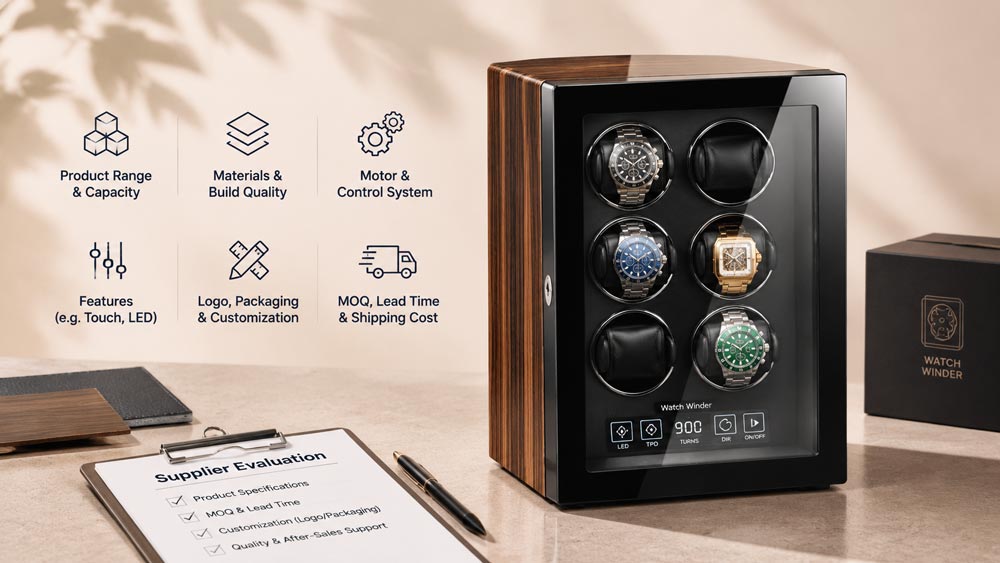
wholesale watch winder prices depend on seven main factors: product capacity, exterior materials, motor configuration, control features, branding, order quantity, and shipping costs. Buyers should compare complete specifications and landed costs rather than choosing suppliers based on unit price alone.
wholesale watch winder pricing is based on the product's construction, components, customization requirements, and order arrangements. Two products with the same winding capacity can have significantly different costs because their materials, motor systems, and additional features are not necessarily the same.
The seven main pricing factors are:
| Pricing Factor | Main Cost Considerations |
|---|---|
| Product Capacity | Number of winding positions, internal structure, and product dimensions |
| Exterior Materials | Wood, MDF, PU leather, metal, glass, and surface finishing |
| Motor and Control System | Motor configuration, rotation programs, TPD settings, and electronic controls |
| Additional Features | Touchscreen, fingerprint lock, LED lighting, and storage compartments |
| Branding and Packaging | Custom logos, retail boxes, manuals, and protective inserts |
| Order Quantity | MOQ, production batches, material purchasing, and setup cost allocation |
| Shipping and Logistics | Package dimensions, gross weight, shipping method, and destination charges |
Understanding these factors allows buyers to identify what is included in a quotation and determine whether two suppliers are offering genuinely comparable products.
Product capacity is one of the most visible factors affecting watch winder costs. Larger models generally require more internal components, additional structural space, and larger packaging.
However, the relationship between capacity and price is not a simple multiplication.
A 6-slot watch winder does not necessarily cost three times as much as a 2-slot model. The actual cost depends on the internal drive architecture, motor arrangement, materials, and shared electronic components.
The following comparison illustrates how capacity influences product construction.
| Product Capacity | Main Structural Requirements | Potential Cost Impact |
|---|---|---|
| 1 Watch | One winding compartment, cushion, and drive system | Compact construction and smaller packaging |
| 2 Watches | Two winding positions and a larger housing | Additional internal components and assembly |
| 4 Watches | Four winding positions and more complex internal layout | Increased structure, wiring, and control requirements |
| 6 Watches | Six winding positions and a larger enclosure | More components and greater packaging volume |
| 9 Watches | Nine winding positions and expanded internal structure | Higher material, assembly, and transportation requirements |
Four considerations explain most capacity-related cost differences.
1. Internal Components
More winding positions may require additional motors, drive mechanisms, cushions, electrical connections, or control channels.
The exact arrangement depends on whether the product uses independent winding systems or a shared drive architecture.
Buyers should ask suppliers how many independent winding systems are included rather than assuming that every winding position has a separate motor.
2. Housing Materials
Larger models require more exterior and interior materials. The housing must also accommodate the expanded winding compartments and associated components.
3. Assembly Complexity
More compartments and electrical connections can increase assembly time and functional inspection requirements.
4. Packaging Dimensions
Larger products require appropriately sized protective packaging. This can increase carton volume and international shipping costs.
For wholesale buyers, capacity should therefore be evaluated together with internal structure and final package dimensions.
Exterior materials influence both manufacturing costs and the final retail positioning of a watch winder.
Wooden, MDF-based, and PU leather products may share similar winding functions while having different material costs, surface treatments, and assembly requirements.
| Exterior Material | Main Characteristics | Pricing Considerations |
|---|---|---|
| Solid Wood | Natural grain and distinctive material appearance | Timber selection, machining, finishing, and material consistency |
| Wood Veneer | Natural wood surface applied to a supporting substrate | Veneer grade, substrate, bonding, and finishing |
| MDF with Wood-Grain Finish | Consistent surface appearance and adaptable construction | MDF thickness, surface film, coating, and edge treatment |
| PU Leather | Flexible exterior covering with different textures and colors | PU grade, backing material, thickness, and surface texture |
| Metal Accents | Decorative or structural metal components | Material grade, machining, plating, and finishing |
| Glass Components | Transparent display panels and doors | Glass specification, processing, edge treatment, and fitting |
Not necessarily. Material cost depends on the actual construction rather than the product's exterior appearance alone.
For example, a wooden-look watch winder may use an MDF substrate with a decorative film or veneer. A PU leather model may use a molded or fabricated housing covered with a selected PU material.
A premium finish can also increase costs even when the underlying structure remains unchanged.
Buyers should distinguish between:
Solid wood and wood veneer.
MDF with decorative film and natural wood finishes.
Standard PU leather and premium textured PU leather.
Standard glass and specially processed display glass.
The material specification should identify the substrate, exterior covering, thickness where relevant, and surface treatment.
The decision should reflect the intended customer group and product positioning.
Wood and wood-grain finishes are suitable for traditional, classic, and premium-looking collections.
PU leather offers flexibility in color, texture, and contemporary retail presentation.
Metal and glass details can create a more technical or modern appearance.
There is no universal material price ranking. A detailed specification is more useful than comparing descriptions such as luxury wood or premium leather without knowing the actual materials.
The motor and control system influence the technical configuration, assembly requirements, and functional performance of a watch winder.
Buyers should compare the motor arrangement and supported winding programs rather than evaluating products based only on their external appearance.
Several technical details can influence the cost:
| Motor Specification | Cost Consideration |
|---|---|
| Motor Configuration | Number of motors and independent drive arrangements |
| Operating Performance | Speed, torque, and operating stability |
| Noise Characteristics | Motor quality and vibration control |
| Rotation Direction | Clockwise, counterclockwise, or bidirectional operation |
| TPD Settings | Available turns-per-day programs |
| Rest Intervals | Programmable winding and rest cycles |
| Electronic Control | Control board, wiring, and program management |
An important distinction is that a watch winder's motor count and winding capacity are not always identical.
Some products use independent motor systems, while others use shared drive arrangements. The number of winding positions alone does not reveal the complete internal configuration.
TPD means Turns Per Day and describes the number of rotations completed during a 24-hour period.
Different automatic watch movements have different winding requirements.
A watch winder with multiple TPD settings may require additional control programming and electronic components, depending on its design.
Buyers should compare:
Available TPD programs.
Rotation direction options.
Winding duration.
Rest intervals.
Whether settings can be controlled independently for different positions.
A product supporting more winding programs may involve a more sophisticated control system, but a higher TPD number does not automatically mean a more expensive or better-performing product.
The actual cost depends on the motor, electronics, and control architecture.
Noise performance can influence motor selection and product construction.
A quieter operating system may require more careful motor selection, vibration control, and assembly.
However, noise claims should be supported by measured results.
Buyers comparing two quotations should request the operating noise level in decibels, along with the testing distance, operating condition, and measurement environment.
A statement such as quiet motor is not a complete technical specification.
Yes. Additional electronic and mechanical features can increase component costs, assembly time, and inspection requirements.
The actual price impact depends on the type of feature and how it is integrated into the product.
| Additional Feature | Main Components or Processes | Purchasing Consideration |
|---|---|---|
| Touchscreen | Display panel, control electronics, and interface components | User interface and program control |
| Fingerprint Lock | Fingerprint recognition module and locking mechanism | Access control and electronic integration |
| LED Lighting | LED components, wiring, and power connections | Interior illumination and display presentation |
| Digital Display | Display module and electronic controls | Operating information and settings |
| Remote Control | Receiver and control electronics | Remote operation |
| Storage Compartment | Additional housing, hinges, and interior materials | Combined winding and storage functionality |
There is no universal touchscreen surcharge.
The cost depends on display size, control functions, electronic architecture, and integration requirements.
A basic touchscreen interface and a more advanced multi-program control panel are not equivalent configurations.
Buyers should request a separate feature breakdown rather than accepting a single price difference without explanation.
A fingerprint locking system generally adds electronic and mechanical components.
The quotation should identify whether the product includes:
A fingerprint recognition module.
An electronic control unit.
A compatible locking mechanism.
Power and connection components.
The required access-control functions.
Fingerprint access control should not automatically be interpreted as certified anti-theft protection or a security safe.
LED lighting can improve the presentation of watches inside a display-style watch winder.
For premium retail collections, lighting may contribute to the product's visual appeal. For entry-level products, additional electronic features may increase costs without providing equivalent commercial value.
Retailers should select features according to their target customers and selling prices rather than maximizing the number of functions.
Private-label requirements can increase the total purchasing cost through branding preparation, printing, materials, and packaging customization.
Buyers should separate one-time setup costs from recurring per-unit costs.
Common branding options include:
| Logo Method | Cost Considerations |
|---|---|
| Screen Printing | Artwork preparation, printing setup, and application |
| Laser Engraving | Engraving time, surface compatibility, and positioning |
| Metal Nameplate | Nameplate material, production, and installation |
| Printed Labels | Label design, printing quantity, and application |
The most suitable method depends on the product's exterior material and finish.
For example, laser engraving may be suitable for selected wooden or coated surfaces, while a metal nameplate may be more appropriate for products requiring a separate brand element.
Packaging is another important cost component for retail-ready products.
The quotation should distinguish between standard protective packaging and customized retail packaging.
| Packaging Component | Potential Cost Impact |
|---|---|
| Retail Gift Box | Box material, size, and printing |
| Protective Insert | Foam, molded insert, or other cushioning material |
| Printed Manual | Paper quality, printing, and language versions |
| Brand Labels | Artwork and label production |
| Outer Carton | Dimensions, strength, and packing quantity |
| Custom Inserts | Additional product information and brand presentation |
A useful purchasing calculation is:
Customization Cost Per Unit = (One-Time Setup Cost ÷ Order Quantity) + Recurring Customization Cost Per Unit
Consider a purely illustrative example:
One-time logo and packaging setup: 300 cost units.
Order quantity: 100 units.
Recurring customization cost: 2 cost units per unit.
The total customization cost per unit is:
300 ÷ 100 + 2 = 5 cost units.
If the same setup cost is allocated across 300 units:
300 ÷ 300 + 2 = 3 cost units per unit.
This example demonstrates why order quantity influences the effective cost of private-label products. The figures are calculation examples, not actual watch winder market prices or TAIHUA quotations.
Buyers should ask suppliers to separate artwork, tooling, printing setup, packaging, and recurring production charges in the quotation.