
Search TAIHUA Products
A practical guide to private label watch winder customization, covering logo placement, exterior finishes, product configurations, winding features, packaging, manuals, sample approval, and supplier coordination for retail brands and distributors.
Category:Private Label & Branding
Author:TAIHUA Admin
Date:2026-11-11
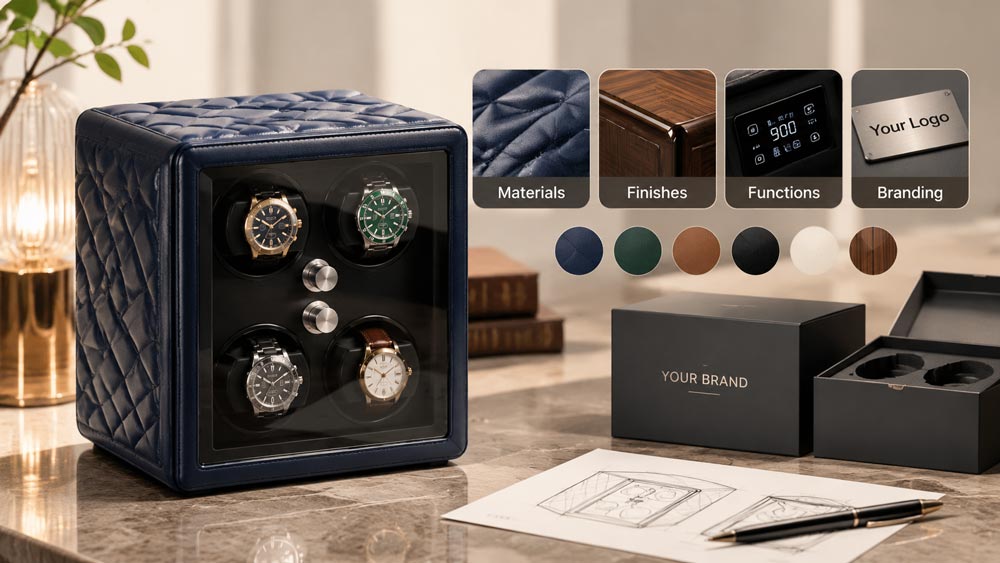
The most important private label watch winder customization options are logo placement, exterior finishes, product configurations, winding functions, retail packaging, and branded product materials. Buyers should prioritize visible brand identity and retail readiness before considering complex product modifications.
private label watch winder customization can be divided into seven areas: product selection, logo application, exterior appearance, functional configuration, power accessories, retail packaging, and product documentation.
Not every option needs to be customized. The best approach is to select suitable existing products and apply consistent branding across the collection.
| Customization Area | Available Options to Evaluate | Business Value |
|---|---|---|
| Product Configuration | Single, double, and multi-watch capacities | Builds a balanced product collection |
| Logo Branding | Logo artwork, placement, and application method | Establishes brand recognition |
| Exterior Appearance | Wood-grain finishes, PU leather, MDF, metal, and selected colors | Creates a consistent visual identity |
| Winding Functions | Rotation direction, TPD programs, and control options on selected models | Matches product requirements |
| Power Accessories | Adapter specifications, voltage, and plug type | Supports destination-market requirements |
| Retail Packaging | Branded boxes, protective inserts, and packaging design | Improves retail presentation |
| Product Materials | Manuals, labels, inserts, images, and product specifications | Supports product sales and customer information |
These options serve different purposes. Logo and packaging customization establish brand identity, while product selection and technical configuration determine what the product actually offers.
For a new private label brand, four areas deserve particular attention: product selection, visual branding, retail packaging, and product information.
Custom logo branding is one of the most important private label requirements because it identifies the product with the retailer's or brand owner's business.
A watch winder may have excellent functionality, but without consistent brand identification, it can be difficult to build a recognizable product collection.
Buyers should evaluate four logo-related details.
Common logo placement areas include:
Front exterior panel.
Upper display area.
Glass or decorative panel where suitable.
Interior brand plate.
Retail packaging.
The best position depends on the product's structure, surface material, and visual design.
A logo should be visible without interfering with the product's overall appearance.
Different surfaces require different branding methods.
Common methods used in product branding include printing, engraving, and separate metal nameplates.
| Logo Method | Main Characteristics | Important Consideration |
|---|---|---|
| Printing | Applies brand graphics directly to a suitable surface | Surface compatibility and print durability |
| Laser Engraving | Creates a permanent marked appearance | Material compatibility and engraving depth |
| Metal Nameplate | Adds a separate branded component | Plate size, finish, and installation |
| Printed Label | Provides flexible product identification | Adhesion and label durability |
These are general branding methods rather than a guarantee that every method is available on every watch winder model. The actual application method should match the selected product.
Before production, buyers should prepare:
Vector logo artwork.
Approved brand colors.
Logo dimensions.
Placement reference.
Preferred application method.
Vector formats such as AI, EPS, and editable PDF are useful because they allow artwork to be scaled without losing clarity.
A private label collection may include single, double, four-watch, and multi-watch winders.
Although their exterior structures differ, the brand identity should remain consistent.
The same approved logo artwork, color standards, and placement principles should be used throughout the collection.
This creates a more recognizable product range and reduces the risk of inconsistent branding between production batches.
Exterior materials and finishes influence product appearance, retail positioning, and perceived value.
Wood-grain finishes, PU leather, MDF, and metal components provide different visual characteristics and can support different brand directions.
| Material or Finish | Visual Characteristics | Suitable Brand Positioning |
|---|---|---|
| Wood-Grain Finish | Natural-looking grain and traditional appearance | Classic and premium collections |
| PU Leather | Textured surface and flexible color presentation | Modern and versatile retail collections |
| MDF with Decorative Finish | Consistent surface appearance and adaptable designs | Mainstream retail products |
| Metal Accents | Contemporary and structured appearance | Modern product collections |
| Glass Display Panels | Transparent presentation of watches | Display-oriented products |
The choice depends on the intended customer group and the overall product design.
Wood-grain finishes are often associated with traditional watch accessories and furniture-style presentation. PU leather provides more flexibility in texture and color selection.
However, the material description should be accurate.
Solid wood, wood veneer, and MDF with a wood-grain surface are different constructions. Similarly, PU leather should not be described as genuine leather.
Buyers should confirm the actual substrate and exterior material before approving product descriptions and packaging.
Yes. A coordinated product collection can use similar color families, surface textures, and decorative elements across different models.
For example, a brand may organize its collection around three visual directions:
Black wood-grain finishes.
Brown wood-grain finishes.
Black or brown PU leather finishes.
This creates a recognizable visual system without requiring every product to have an identical structure.
Selected material and color availability should be matched to the actual product models.
Product configuration should be selected according to the brand's target market and product positioning.
Capacity is particularly important because it determines how many automatic watches a product can wind simultaneously.
A private label collection can include several configurations.
| Configuration | Main Product Positioning |
|---|---|
| Single Watch Winder | Compact entry-level product |
| Double Watch Winder | Everyday retail collection |
| Triple Watch Winder | Intermediate capacity |
| 4-Watch Winder | Multi-watch collector product |
| 6-Watch Winder | Premium collection |
| 9-Watch Winder | High-capacity collector product |
The first priority should be choosing the right existing product structures rather than requesting unnecessary structural modifications.
Three factors are particularly important:
1. Target Customer
Customers who own one or two automatic watches have different requirements from collectors with larger collections.
2. Retail Price Positioning
Higher-capacity products generally require more materials, larger housings, and more extensive packaging. Their cost structure should be evaluated separately.
3. Product Collection Balance
A collection should provide meaningful differences between models.
For example, offering three products with almost identical capacities and appearances may create unnecessary overlap.
A better approach is to combine different capacities and visual styles to establish clear product positions.
Product dimensions are part of the technical specification and should be evaluated according to the selected model.
Changes to the overall housing, internal compartments, or winding structure may involve engineering work rather than standard private label customization.
For brands working with existing product designs, selecting a suitable model is generally more straightforward than requesting structural redesign.
Functional features can influence the product's retail positioning, technical specification, and manufacturing cost.
However, there is an important distinction between selecting an existing feature configuration and developing a new electronic system.
Buyers should first compare the functions already available across different product models.
| Feature | Main Function | Purchasing Consideration |
|---|---|---|
| Adjustable TPD | Provides different turns-per-day settings | Compatibility with intended automatic watch movements |
| Rotation Direction | Supports clockwise, counterclockwise, or bidirectional rotation | Required winding direction |
| Rest Intervals | Controls winding and resting periods | Operating program |
| Touchscreen | Provides a digital control interface | User experience and available settings |
| Fingerprint Lock | Provides fingerprint-based access control | Security and locking configuration |
| Remote Control | Enables remote operation on supported models | Control convenience |
| LED Lighting | Illuminates the watch display area | Product presentation |
| Digital Display | Shows operating information | Control and information visibility |
Some existing watch winder configurations include touchscreen controls, fingerprint locks, remote operation, LED lighting, and adjustable winding settings.
These features should be treated as model-specific product options. Buyers should not assume that a standard model can automatically receive every electronic feature through a simple customization request.
Yes. Motor configuration directly affects winding performance and operating characteristics.
Buyers should evaluate:
Motor type.
Operating stability.
Noise characteristics.
Rotation direction.
Supported TPD settings.
Programmed rest intervals.
For example, selected existing products may use Japanese Mabuchi brushless motors. However, the motor specification should be checked against the individual product rather than assumed to apply across an entire collection.
Changing motor architecture, control chips, or electronic systems is different from choosing an existing product configuration. Such changes should not be presented as standard logo or private label customization.
Not necessarily.
A more practical collection may use basic controls for entry-level models and advanced features for premium models.
This creates a clear distinction between products and allows retailers to organize their collection around different customer requirements.
Retail packaging is an essential part of private label branding because it influences product presentation, transportation protection, and the customer's overall purchasing experience.
A customized watch winder should have packaging that reflects the same brand identity as the product itself.
Five packaging elements deserve attention.
| Packaging Element | Customization Focus |
|---|---|
| Outer Retail Box | Brand logo, colors, typography, and product identification |
| Protective Insert | Product positioning and impact protection |
| Interior Presentation | Organized placement of the product and accessories |
| Printed Manual | Brand information and operating instructions |
| Product Label | Model identification and technical information |
A retail-ready box should normally communicate:
Brand name and logo.
Product name.
Main product specifications.
Product capacity.
Key functions.
Model identification.
The packaging should not make technical claims that are different from the actual product configuration.
For example, a model with four winding positions should not be described as a six-watch automatic winder simply because it includes additional storage compartments.
These two packaging requirements serve different purposes.
Retail Packaging focuses on brand identity, product presentation, and customer information.
Export Packaging focuses on protecting the product during handling, transportation, and storage.
A private label project should consider both.
Large watch winders may require additional internal cushioning and stronger outer cartons because their display structures, glass components, and exterior finishes can be vulnerable during transportation.
Yes. Product documentation is often overlooked during private label development, but it is important for retail sales and customer support.
A branded watch winder collection should use consistent product information across packaging, manuals, online listings, and sales materials.
Four documentation elements are particularly useful.
1. User Manuals
Manuals should explain product operation, winding programs, power connection, and basic maintenance.
2. Product Labels
Labels can communicate model identification, power specifications, and other relevant product information.
3. Specification Sheets
Each SKU should have a clear technical specification sheet covering dimensions, capacity, materials, motor configuration, and available functions.
4. Retail Inserts
Branded inserts can provide product information, operating guidance, warranty information, and customer support details.
Different watch winder models may have different dimensions, motor configurations, control systems, and power requirements.
A separate specification sheet for each SKU helps prevent incorrect product information from appearing in online listings and printed materials.
For a collection of four models, the recommended documentation package includes four model-specific specification sheets and one shared brand presentation standard.
This makes product information easier to manage as the collection expands.
Previous: