
Search TAIHUA Products
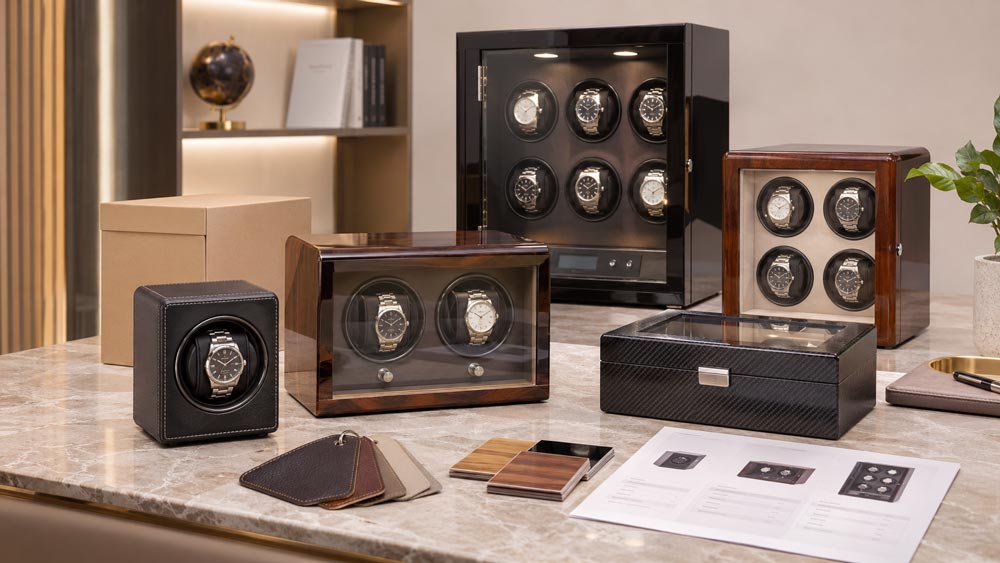
Buyers should evaluate a watch winder supplier based on seven factors: product range, technical specifications, wholesale and private-label capabilities, MOQ, lead time, sample availability, quality control, and after-sales support. Long-term suitability depends on consistent product quality and reliable order management.
Choosing the right watch winder supplier affects more than the initial purchasing cost. It determines product consistency, inventory planning, private-label development, customer satisfaction, and the ability to replenish stock as sales grow.
The watch retail market also requires suppliers to understand different customer segments.
The 2025 Swiss Watch Industry Study surveyed 6,500 consumers and 111 senior executives. Its findings showed that 38% of consumers preferred multi-brand watch stores, compared with 23% who preferred mono-brand boutiques. Additionally, 40% of Millennials and younger consumers expressed an intention to purchase a pre-owned watch within the following 12 months.
These findings highlight the importance of product selection and assortment planning for retailers serving different watch-buying groups. They do not directly measure watch winder demand, but they provide useful context for accessory businesses.
For B2B buyers, a qualified supplier should therefore provide more than individual products. The supplier should support a commercially suitable product range, consistent specifications, and a purchasing arrangement that matches the buyer's business model.
A qualified watch winder supplier should offer multiple capacities, designs, materials, and configurations to support different retail positions and customer requirements.
Product range is one of the first things buyers should evaluate because relying on only one or two models can limit collection development and future product expansion.
The following configurations are useful when evaluating a supplier's catalogue:
| Product Type | Capacity | Typical Retail Positioning |
|---|---|---|
| Single Watch Winder | 1 watch | Entry-level and compact collections |
| Double Watch Winder | 2 watches | Everyday retail accessories |
| triple watch winder | 3 watches | Growing watch collections |
| 4-Slot Watch Winder | 4 watches | Mid-range collector products |
| 6-Slot Watch Winder | 6 watches | Premium watch collections |
| 9-Slot Watch Winder | 9 watches | High-capacity collector products |
Buyers should also compare the following product characteristics:
Exterior materials such as wood, MDF, leather, and metal.
Available colors and surface finishes.
Interior lining and adjustable watch cushions.
Touchscreen and traditional control systems.
Fingerprint locks and other available security features.
Additional storage compartments.
Different motor and winding configurations.
A supplier with a wider product range can help retailers develop entry-level, mainstream, and premium collections without changing suppliers for every product category.
For example, the current TAIHUA product catalogue lists 12 watch winder models, covering single-watch, double-watch, triple-watch, four-watch, six-watch, and nine-watch configurations, as well as combined winding and storage solutions.
The key is not simply counting product models. Buyers should determine whether the available models serve different customer segments and whether the supplier can maintain consistent specifications across the range.
A suitable B2B watch winder supplier should clearly distinguish between standard wholesale purchasing and private-label cooperation.
Wholesale purchasing allows retailers and distributors to source existing models for resale. Private labeling adds brand identification and selected customization options to support the buyer's own product collection.
The two purchasing models serve different business requirements.
| Requirement | Wholesale Supply | Private Label Supply |
|---|---|---|
| Existing Product Models | Available | Available |
| Bulk Purchasing | Supported according to order terms | Supported according to order terms |
| Custom Logo | Depends on arrangement | Available options should be confirmed |
| Exterior Colors | Selected existing options | Selected customization options |
| Retail Packaging | Standard packaging | Branding and packaging options |
| Product Manuals | Standard versions | Customized versions where available |
| Brand Presentation | Supplier product identity | Buyer's brand identity |
Before selecting a supplier, buyers should ask about five customization areas:
Logo Application: Can the supplier apply a custom logo through printing, engraving, or a nameplate?
Exterior Finishes: Are different colors, materials, or finishes available?
Retail Packaging: Can product boxes and protective inserts carry the buyer's branding?
Product Identification: Can labels, manuals, and product information be customized?
Marketing Materials: Can the supplier provide product images, specifications, and sales content?
One important distinction is the difference between product customization and product engineering.
Logo application, selected finishes, and packaging customization are common private-label requirements. Structural redesign, motor development, and electronic system development require additional manufacturing capabilities.
Buyers should ask suppliers to provide a clear customization list rather than relying on a general statement such as "Full OEM and ODM Available."
A transparent customization scope helps prevent misunderstandings during quotation, sampling, and bulk production.
MOQ and lead time should match the buyer's inventory budget, sales forecast, and replenishment schedule.
MOQ refers to the minimum order quantity required for a particular purchasing arrangement. It may vary between standard models, mixed-model orders, customized logos, and retail packaging.
Buyers should request separate MOQ information for:
Standard watch winder models.
Private-label products with custom logos.
Orders with customized packaging.
Mixed-model wholesale orders.
Repeat orders using previously approved specifications.
A practical approach is to request quotations at three purchasing levels:
| Order Scenario | Main Evaluation Purpose |
|---|---|
| Initial Trial Order | Evaluate market response and product acceptance |
| Regular Wholesale Order | Determine normal purchasing costs |
| Higher-Volume Order | Understand volume pricing and supply capacity |
This comparison helps buyers understand whether the supplier can support both initial market testing and future business expansion.
A quotation should distinguish between four different time periods:
Sample preparation and approval.
Logo and packaging confirmation.
Bulk production.
Final inspection and shipment preparation.
Buyers should also confirm whether the quoted production time begins after deposit payment, artwork approval, sample confirmation, or another agreed milestone.
A supplier offering a short initial production schedule is not necessarily the best option if repeat orders cannot be planned consistently.
The more important question is whether the supplier can communicate realistic delivery schedules and maintain them across multiple purchasing cycles.
Sample availability is an important supplier qualification requirement because product photographs and specification sheets cannot fully demonstrate actual product performance.
Buyers should request physical samples before committing to a substantial wholesale order, particularly when purchasing a new model or developing a private-label collection.
A proper watch winder sample evaluation should cover at least eight areas.
| Inspection Item | What Buyers Should Verify |
|---|---|
| Exterior Appearance | Material, color, finish, and visible defects |
| Product Construction | Assembly, joints, and structural stability |
| Watch Pillow | Fit, adjustment, and watch-holding stability |
| Motor Operation | Smooth and consistent operation |
| Rotation Direction | Correct clockwise and counterclockwise settings |
| TPD Settings | Available turns-per-day programs |
| Noise Performance | Unusual noise and vibration during operation |
| Packaging | Product protection and accessory completeness |
Technical specifications should be checked against the intended watch movements.
For example, TPD refers to turns per day. Different automatic watch movements have different winding requirements, so buyers should confirm the supported TPD settings and rotation directions for each model.
An approved sample should become the reference for subsequent bulk production.
The buyer and supplier should document:
Product model and configuration.
Exterior materials and finish.
Motor and control settings.
Logo placement.
Included accessories.
Packaging specifications.
This reference is commonly called a golden sample.
If the supplier changes a motor, material, finish, or other important component, the change should be communicated and approved before production continues.
The objective is to ensure that the delivered products match the specifications that the buyer originally evaluated.
A reliable watch winder supplier should be able to explain what is inspected, when inspections take place, and how defects are handled.
Quality control should cover both product functionality and physical condition.
Six important inspection areas include:
| Quality Check | Inspection Focus |
|---|---|
| Motor Operation | Stable motor operation and winding performance |
| Rotation Direction | Correct operation of selected rotation programs |
| Control Functions | Buttons, touchscreen, and control response |
| Noise Performance | Abnormal noise or vibration |
| Surface Condition | Scratches, finish consistency, and visible defects |
| Packaging | Product protection, accessories, and carton condition |
Buyers should also ask four specific questions:
Are functional checks performed on every unit or through sampling?
What inspection criteria are used before shipment?
Are inspection records available?
How are defective products identified and handled?
The inspection scope should be documented rather than described only through general statements such as "Strict Quality Control."
Sample inspection evaluates whether a selected product meets the agreed requirements before an order is placed.
Bulk inspection evaluates whether the manufactured products consistently match the approved sample and purchase specifications.
Both stages are important.
A product passing sample inspection does not automatically guarantee that every unit in a large order will have identical performance.
Buyers should therefore agree on inspection requirements before bulk production begins and confirm how non-conforming products will be handled.
After-sales support is particularly important for electronic watch winders because motors, adapters, control systems, and other components may require replacement during the product's service life.
Retailers and distributors should confirm spare-parts availability before placing bulk orders.
Important items to discuss include:
| Spare Part or Support Item | Purchasing Consideration |
|---|---|
| Motor Components | Availability and model compatibility |
| Power Adapters | Correct voltage and plug specifications |
| Control Components | Replacement availability and technical support |
| Connection Cables | Compatible replacement options |
| Watch Pillows | Replacement sizes and configurations |
| Operating Manuals | Product instructions and troubleshooting |
| Warranty Policy | Coverage, exclusions, and claim procedures |
Buyers should not assume that every supplier can provide every replacement component.
Instead, request a model-specific spare-parts list and confirm the process for obtaining replacements.
Three details are especially important:
Which parts can be supplied separately?
What information is required to identify the correct replacement?
What is the expected response and fulfillment time for a spare-parts request?
A supplier that can coordinate replacement parts and technical information provides additional support for retailers managing customer complaints and warranty cases.
Long-term supplier suitability should be evaluated through repeatability, communication, documented responsibilities, and after-sales performance rather than the first quotation alone.
A practical supplier assessment can use a 100-point evaluation framework.
| Evaluation Category | Weight |
|---|---|
| Product Range and Market Fit | 15 |
| Technical Specifications and Sample Performance | 20 |
| Quality Inspection and Documentation | 20 |
| MOQ, Lead Time, and Supply Planning | 15 |
| Wholesale and Private Label Capabilities | 10 |
| Spare Parts and After-Sales Support | 10 |
| Communication and Issue Resolution | 10 |
| Total | 100 |
The following internal scoring rules can help buyers compare shortlisted suppliers:
85–100 points: Preferred candidate for a trial order.
70–84 points: Potential candidate, but outstanding issues should be resolved.
Below 70 points: Not recommended without significant improvements.
This is a proposed procurement evaluation framework, not an industry certification or universal supplier rating standard.
Regardless of the total score, three requirements should be treated as essential:
The approved sample must meet the required specifications.
Product quality and inspection responsibilities must be documented.
Warranty, defect handling, and replacement-part arrangements must be clear.
Supplier evaluation should continue after the initial purchase.
A useful approach is to review the first three order cycles and track four operational indicators.
1. On-Time Delivery Rate
On-time delivery rate = Orders delivered by the agreed date / Total completed orders × 100%
2. Product Defect Rate
Defect rate = Confirmed defective units / Total inspected units × 100%
3. Response Time
Measure the time between submitting a product or order issue and receiving the supplier's first actionable response.
4. Spare Parts Fulfillment Rate
Spare parts fulfillment rate = Replacement-part orders delivered by the promised date / Total replacement-part orders × 100%
These measurements help buyers distinguish between a supplier that performs well during the first transaction and one that can support a sustainable purchasing relationship.
Not necessarily. Buyers should evaluate the supplier's actual responsibilities and ability to control the supply process rather than relying only on factory ownership.
A manufacturer, trading company, or specialized supply partner can serve different purchasing needs.
However, the supplier should clearly identify:
Who is responsible for manufacturing.
Who confirms the final product specifications.
Who coordinates quality inspections.
Who manages packaging and delivery.
Who handles product defects and after-sales requests.
The most important requirement is clear accountability.
A supplier that coordinates products, branding, quality requirements, and order follow-up effectively may be more suitable than a factory that offers production capacity but limited commercial support.